

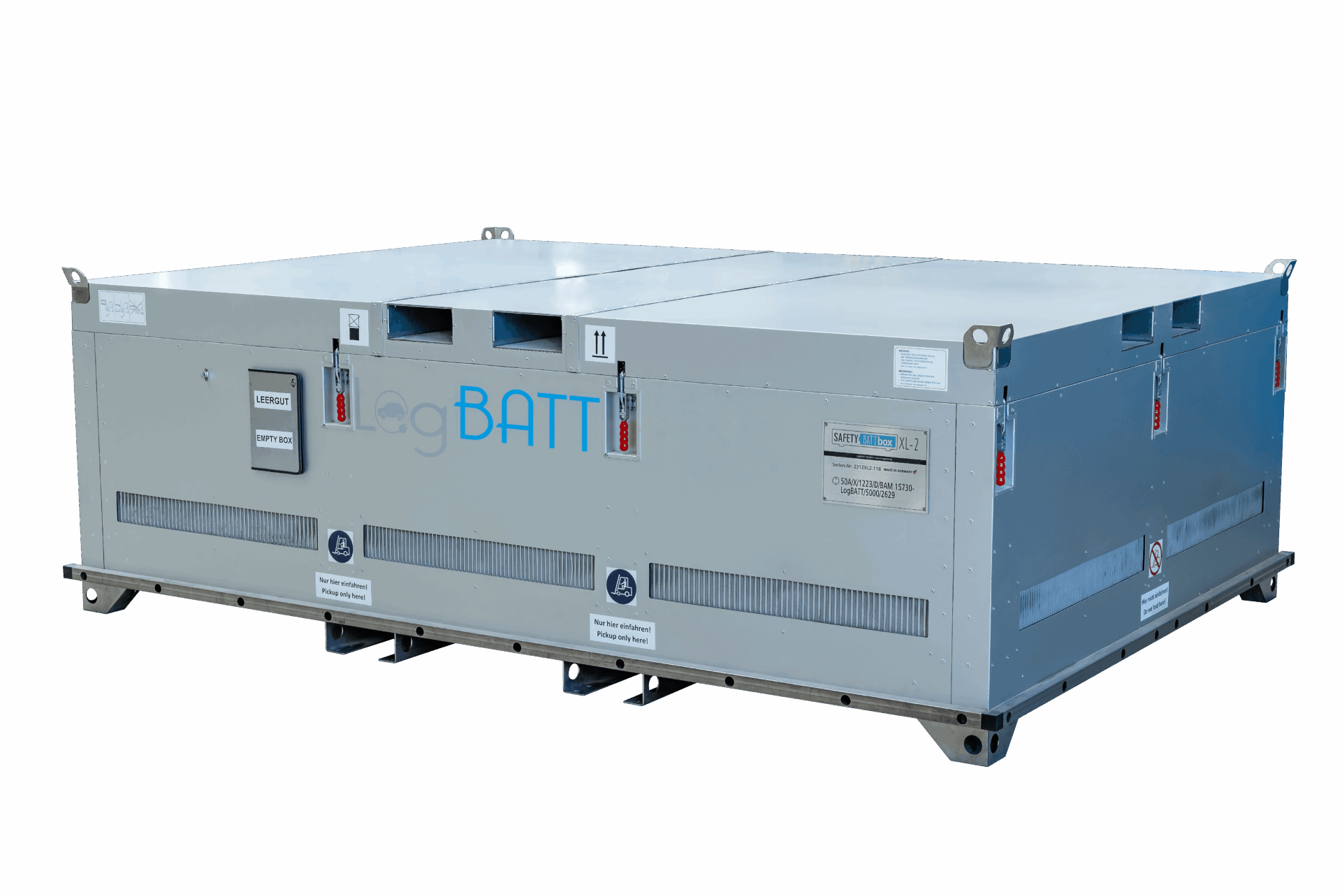
The SafetyBATTbox product family was developed to cope with accidents according to the latest legal dangerous-goods requirements and fulfils the BAM requirements as per ADR 2025 and the U.S. DOT:
LogBATT’s SafetyBATTboxes have successfully passed 45 real fire tests
LogBATT holds an approved procedure (Verfahrensfestlegung) as per P911/LP906
Transport Crates for Lithium-Ion Batteries — The SafetyBATTbox Product Family from LogBATT
With the SafetyBATTboxes, LogBATT offers certified solutions for the transport, quarantine, storage and emergency handling of lithium batteries – compliant with ADR dangerous-goods Class 9, the relevant packing instructions (P903, P908, P909, P910, P911, LP903, LP904, LP905, LP906) and special provisions SP 310, SP 376 and SP 377.
Our solutions are suitable for:
- damaged lithium batteries, lithium rechargeable batteries and lithium cells
- defective or critical batteries
- ADR-compliant battery transport
- safe storage of lithium batteries and lithium cells
- emergency and quarantine situations
- industry, logistics, workshops and waste-disposal operations
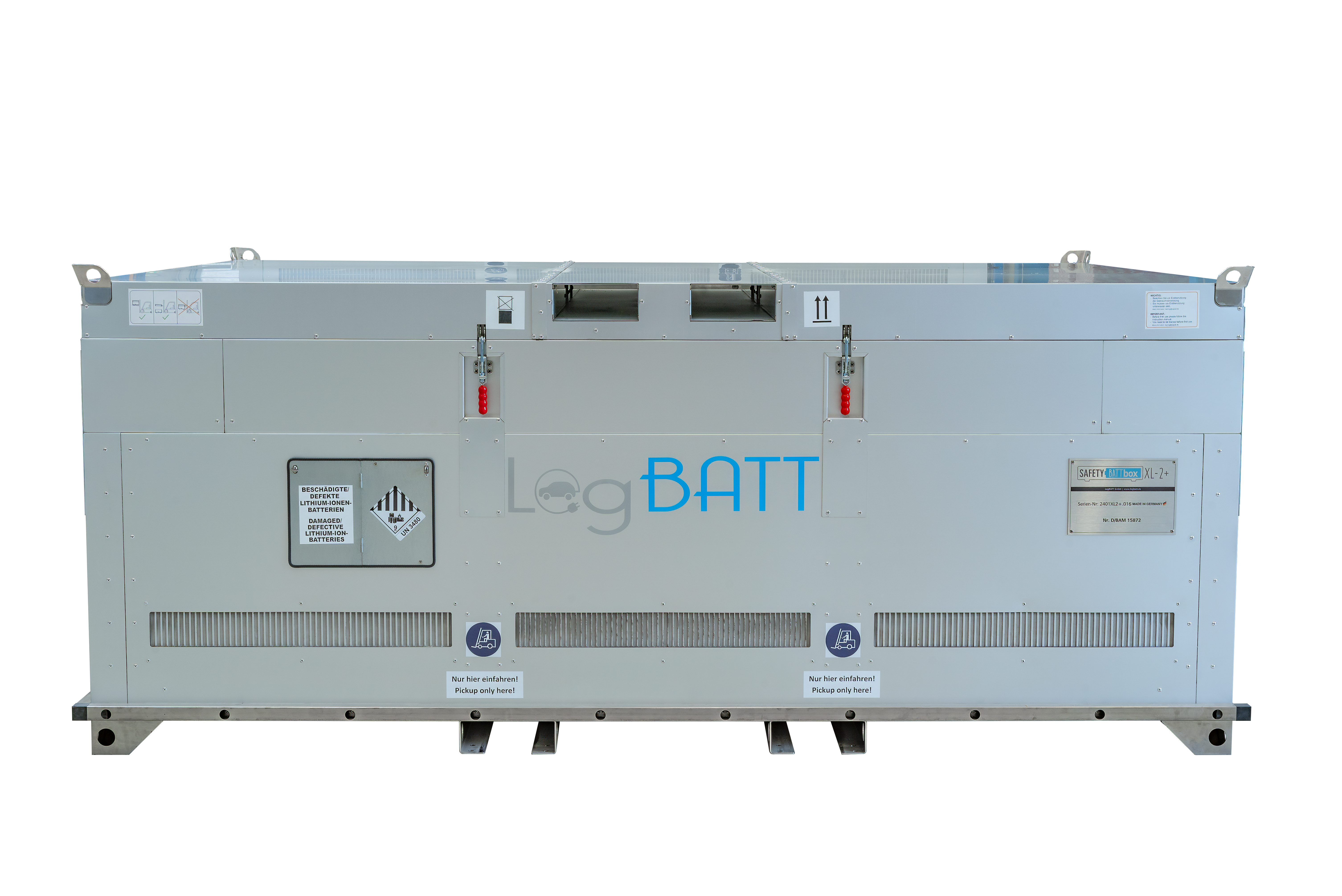
SafetyBATTbox XL-2.2+
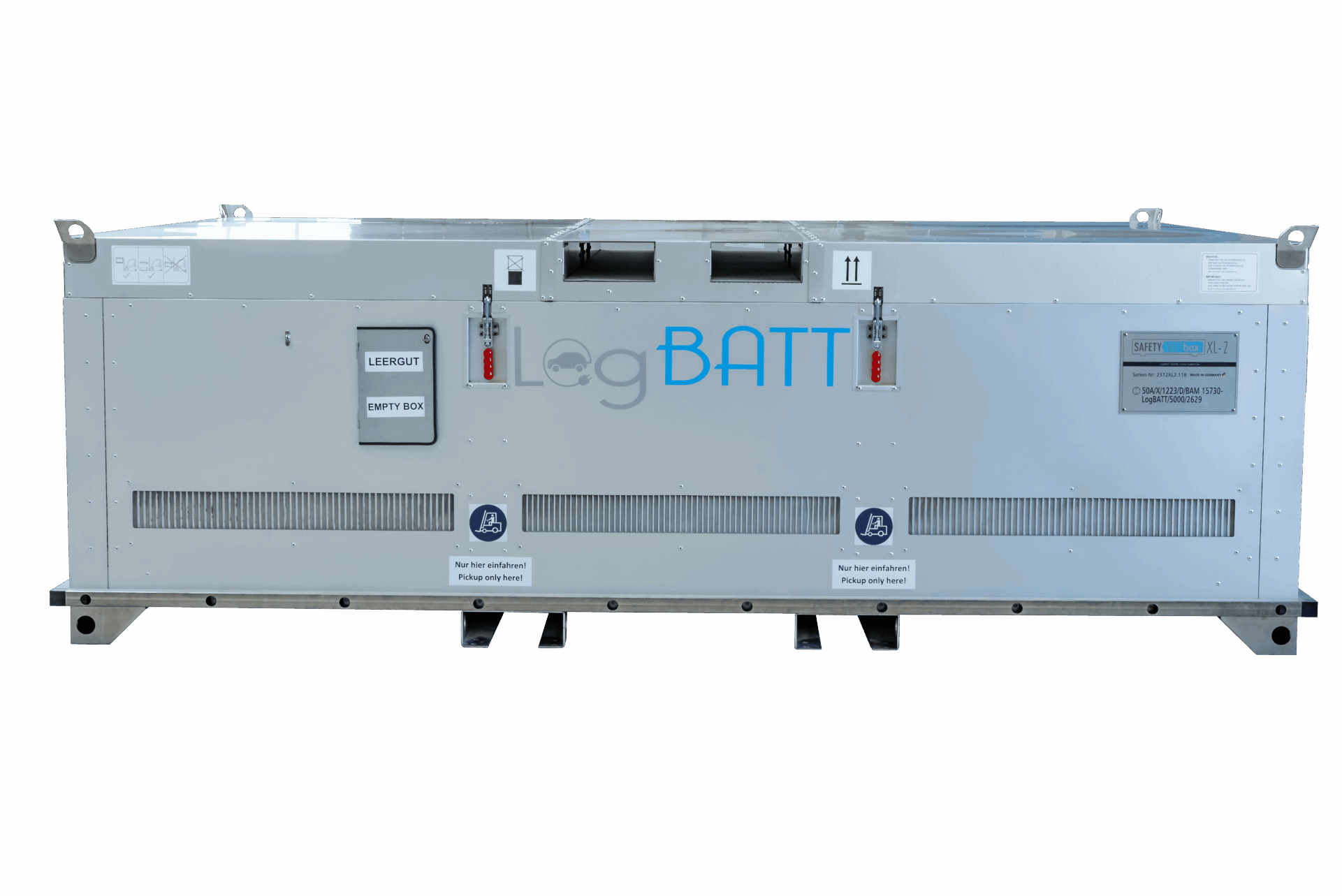
SafetyBATTbox XL 2.2
SafetyBATTbox XL-lite
SafetyBATTbox L-2
SafetyBATTbox M-2
SafetyBATTbox S-1
SafetyBATTbox S-1-lite
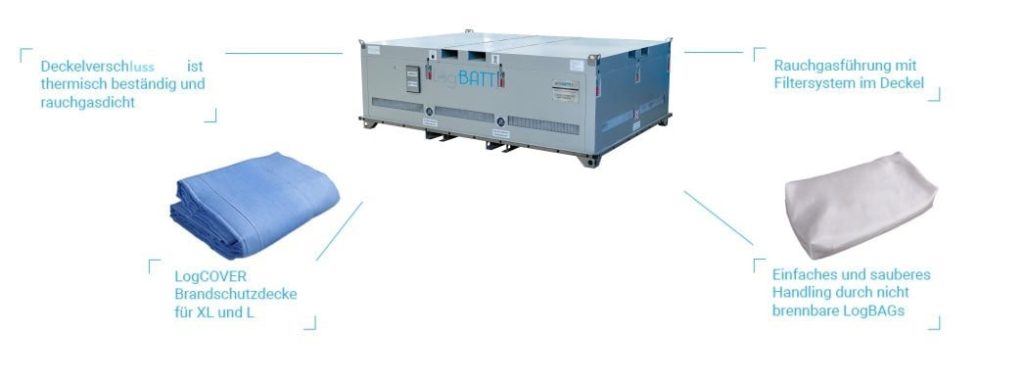
Regulatory framework for lithium battery transport
Damaged, defective or critically unstable lithium batteries, lithium rechargeable batteries and lithium cells assigned to the UN numbers
- UN 3090 – Lithium metal batteries
- UN 3091 – Lithium metal batteries contained in or packed with equipment
- UN 3480 – Lithium-ion batteries
- UN 3481 – Lithium-ion batteries contained in or packed with equipment
pose a considerable risk of fire, explosion and the release of toxic gases. Mechanically damaged lithium batteries, deeply discharged batteries or batteries with an internal short circuit are particularly dangerous, because even minor damage can trigger a so-called thermal runaway.
Depending on the mode of transport, different dangerous-goods regulations apply to the safe and compliant transport of damaged lithium batteries:
- ADR for road transport
- RID for rail transport
- IATA-DGR for air freight
- IMDG Code for sea transport
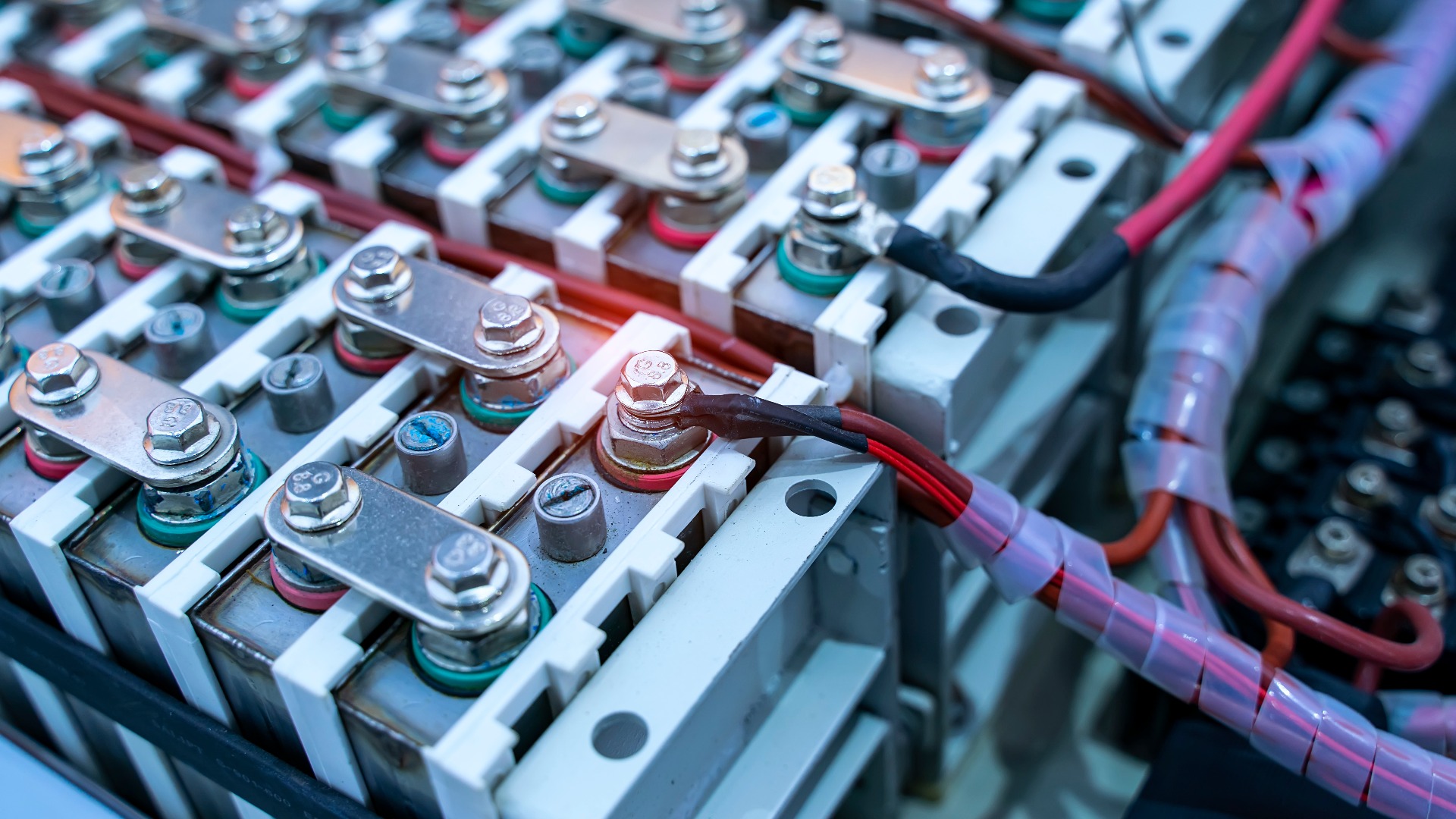
In addition, the following regulations and packing instructions are relevant, among others, for damaged, defective or critically defective lithium batteries and lithium cells:
- ADR special provision SP 376 – governs the transport of damaged and defective lithium cells/batteries and refers to the applicable packing instruction
- Packing instruction P908 for damaged and defective cells and batteries
- Packing instruction P911 for critically defective cells and batteries (risk of flaming, heat generation, gas emission)
- Large packing instruction LP904 for individually packaged damaged/defective cells and batteries
- Large packing instruction LP906 for critically defective cells and batteries
- ADR special provision SP 377 – governs the transport of lithium batteries for disposal or recycling (provided they are not damaged under SP 376)
- Packing instruction P909 for cells and batteries for disposal and recycling
- ADR special provision SP 310 – governs the transport of prototypes and small production runs (fewer than 100 units, or before completion of the UN 38.3 test)
- Packing instruction P910 for prototypes and small production runs of cells and batteries
- Large packing instruction LP905 for prototypes and small production runs of cells and batteries
- General packing provision (no special-provision reference; applies to “normal”, undamaged and series-tested batteries under UN 38.3, unless exempted under SP 188)
- Packing instruction P903 for cells and batteries
- Large packing instruction LP903 for large cells (> 500 g) and batteries (> 12 kg)
Overarching and product-related requirements (apply additionally / in general):
- Dangerous-goods Class 9 under ADR – classification of all lithium batteries (UN 3090, 3091, 3480, 3481) as miscellaneous dangerous substances and articles
- Requirements under the UN Manual of Tests and Criteria, section 38.3 (UN 38.3) – a prerequisite for shipping series-tested cells/batteries; does not apply under SP 310 (prototypes) and partly under SP 376/377
- BAM-tested and UN-certified packaging for lithium batteries – design-type approval of the specific packaging (drums, boxes, large packagings) required by the respective P/LP instructions
Application in Great Britain: ADR is given legal force for domestic carriage in Great Britain by the Carriage of Dangerous Goods and Use of Transportable Pressure Equipment Regulations 2009 (CDG 2009). The requirements that matter for lithium batteries are identical across Europe, because they derive directly from ADR:
- BAM design-type approvals are recognised in all ADR contracting parties, including Great Britain, under the principle of mutual recognition – so the SafetyBATTboxes may be used for carriage in and from the UK without additional approval. In GB the competent authority is the Department for Transport (DfT); the Vehicle Certification Agency (VCA) Dangerous Goods Office certifies dangerous-goods packaging.
- Businesses that consign, load or carry dangerous goods must appoint a Dangerous Goods Safety Adviser (DGSA) (ADR 1.8.3).
- The UN numbers (UN 3090/3091/3480/3481), the packing instructions (P903–P911 / LP903–LP906), the special provisions (SP 310/376/377) and Class 9 apply uniformly; there are no national deviations for the packaging itself.
Swollen laptop or e-bike batteries, which may appear externally undamaged after a fall, as well as damaged traction batteries in electric vehicles, can quickly become a major hazard. In such cases, safe interim storage until a compliant transport takes place is essential.
Manufacturer recall campaigns or battery replacements in workshops make consistent recycling logistics necessary.
Thermal runaway: the core risk in battery transport
Even minor mechanical damage, ageing, overcharging or improper charging can cause lithium battery cells to undergo a thermal reaction, known in technical terms as thermal runaway. This refers to an uncontrolled self-heating process that continually intensifies and produces large quantities of smoke gas, through which the pressure inside the cell can rise so sharply that an explosion and, subsequently, a violent fire can occur. Because a battery usually consists of many individual cells, a fire in a single cell is likely to spread to neighbouring cells. This effect is known as thermal propagation and very quickly turns the fire of a single battery cell into an uncontrollable blaze.
You can picture it like an avalanche:
- Small at first
- Then it accelerates on its own
- And grows ever larger and more destructive
Swollen laptop or e-bike batteries, which may appear externally undamaged after a fall, as well as damaged traction batteries in electric vehicles, can quickly become a major hazard. In such cases, safe interim storage until a compliant transport takes place is essential.
Manufacturer recall campaigns or battery replacements in workshops make consistent recycling logistics necessary.
LogBATT safety solutions for thermal-runaway events
LogBATT’s SafetyBATTboxes are UN-certified by the BAM (the German Federal Institute for Materials Research and Testing) through fire tests and further examinations such as drop tests, stacking-pressure tests and lifting tests in accordance with ADR 6.1, and thereby protect people and the environment. With their robust construction from steel, a stainless-steel inner tray and – depending on the version – outer walls made of anodised aluminium or coated steel, LogBATT’s SafetyBATTboxes provide mechanical protection against projectiles or escaping flames. The gas management system enables pressure relief and filtering of the smoke gases. The insulation of the boxes keeps the temperatures at the outer walls of the SafetyBATTbox below the permitted 100 °C during a battery fire. By using our reusable LogBAGs as packing material, we can dispense with elaborate load securing inside the box.
Areas of application of the LogBATT SafetyBATTbox product family
The SafetyBATTbox family covers the entire range of damaged, defective and critically defective lithium-ion batteries – from the small power-tool cell to the complete EV traction battery. Depending on battery size, weight and condition – and therefore on the applicable packing instruction – a different model is used.
Typical use cases are swollen or thermally conspicuous batteries from workshops, crashed vehicle batteries after an accident, returns from recall campaigns, and prototypes from development that have not yet completed the UN 38.3 test. The regulated onward transport of batteries for disposal or recycling under SP 377 also falls within the scope of application of the SafetyBATTbox family.
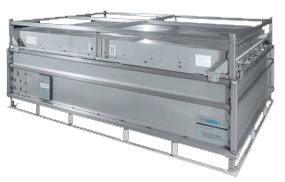
Product overview: the SafetyBATTbox family at a glance
Products

SafetyBATTbox XL-2.2+
- The SafetyBATTbox XL-2.2+ is suitable for heavy and large cells, batteries or battery modules from passenger cars or commercial vehicles, with a payload of up to 1,700 kg
- Inner tray made of steel (stainless steel), outer cladding made of anodised aluminium
- Design-type approval: packing group I (ADR, RID, IATA-DGR and IMDG)
- BAM approval D-BAM 16336 for large packing instruction LP906 (for critically defective cells or batteries) up to 166 kWh
- Dimensions:
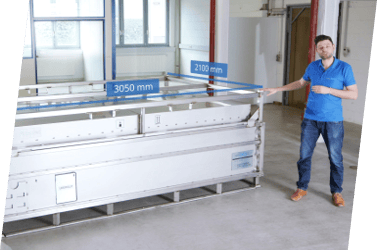
- 3,233 x 2,284 x 1,350 mm (external)
- 2,790 x 1,820 x 797 mm (internal)

SafetyBATTbox XL-2.2
- The SafetyBATTbox XL-2.2 is suitable for large cells, batteries or battery modules from passenger cars or commercial vehicles, with a payload of up to 1,129 kg
- Inner tray made of steel (stainless steel), outer cladding made of anodised aluminium
- Design-type approval: packing group I (ADR, RID, IATA-DGR and IMDG)
- BAM approval D-BAM 15730 for large packing instruction LP906 (for critically defective cells or batteries) up to 113.2 kWh
- Dimensions:
- 3,233 x 2,284 x 1,095 mm (external)
- 2,790 x 1,820 x 542 mm (internal)

SafetyBATTbox XL-lite
- The SafetyBATTbox XL-lite is suitable for large cells, batteries or battery modules from passenger cars or commercial vehicles, with a payload of up to 900 kg
- Plastic housing
- Design-type approval: packing group II (ADR, RID, IATA-DGR and IMDG)
- BAM approval D-BAM 16059 for large packing instructions LP903 (for cells and batteries), LP904 (for damaged cells and batteries) and LP905 (for prototypes and small production runs of cells and batteries)
- Dimensions:
- 2,965 x 1,863 x 847 mm (external)
- 2,870 x 1,770 x 590 mm (internal)

SafetyBATTbox L-2
- The SafetyBATTbox L-2 is suitable for cells, batteries or battery modules from passenger cars or commercial vehicles, e-bikes, laptops or electrical devices, with a payload of up to 357 kg
- Inner tray made of steel (stainless steel), outer cladding made of galvanised steel
- Design-type approval: packing group I (ADR, RID, IATA-DGR and IMDG)
- BAM approval D-BAM 15891 for packing instruction P911 (for critically defective cells or batteries) up to 28.35 kWh
- Dimensions:
- 1,606 x 1,200 x 964 mm (external)
- 1,312 x 913 x 472 mm (internal)

SafetyBATTbox M-2
- The SafetyBATTbox M-2 is suitable for cells, batteries or battery modules from passenger cars or commercial vehicles, e-bikes, laptops or electrical devices, with a payload of up to 30 kg
- Inner tray made of steel (stainless steel), outer cladding made of galvanised steel
- Design-type approval: packing group I (ADR, RID, IATA-DGR and IMDG)
- BAM approval D-BAM 15468 for packing instruction P911 (for critically defective cells or batteries) up to 3.036 kWh
- Dimensions:
- 1,000 x 600 x 700 mm (external)
- 816 x 416 x 306 mm (internal)

SafetyBATTbox S-1
- The SafetyBATTbox S-1 is suitable for cells, batteries or battery modules from e-bikes, laptops or power tools, with a payload of up to 10 kg
- Plastic housing
- Design-type approval: packing group I (ADR, RID, IATA-DGR and IMDG)
- BAM approval D-BAM 15937 for packing instruction P911 (for critically defective cells or batteries) up to 500 Wh
- Dimensions:
- 600 x 400 x 340 mm (external)
- 480 x 280 x 180 mm (internal)
SafetyBATTbox S-1-lite
- The SafetyBATTbox S-1-lite is suitable for cells, batteries or battery modules from e-bikes, laptops or power tools, with a payload of up to 15 kg
- Plastic housing
- Design-type approval: packing group II (ADR, RID, IATA-DGR and IMDG)
- BAM approval D-BAM 16387 for packing instructions P903 (for cells and batteries), P908 (for damaged and defective cells and batteries), P909 (for cells and batteries for disposal and recycling) and P910 (for prototypes and small production runs of cells and batteries)
- Dimensions:
- 600 x 400 x 340 mm (external)
- 480 x 280 x 180 mm (internal)
Your advantages
- All fire-protection containers tested in real-world conditions and officially approved
- Everything from a single source (development and production)
- The simplest box-handling system on the market
- LogBATT is itself the manufacturer and is QSP-certified
- Ready for immediate use
- No inner packaging required
- Multiple modes of transport: road (ADR) as well as rail (RID) and sea transport (IMDG Code)
- Multifunctional; also for prototypes (SP 310) or damaged batteries (SP 376)
- Approval for the US market available (DOT U.S. special permit)
- In-house testing including battery reconstruction
- Future-proof: LogBATT holds the approved procedure for P911/LP906
- Suitable for outdoor use
- Multiple batteries can be transported in one packaging
- No maintenance required
- GPS tracking and sensor evaluation
- Purchase or rental
- No flames, projectiles or mechanical damage outside the fire-protection container
- Filter system
- Temperatures at the container’s outer walls permanently below 100 °C
- Controlled smoke-gas routing and smoke release through defined openings
- Hydrogen fluoride (HF) filtering
- Design-type-approved, X-coded UN packaging (packing group I, dangerous-goods packaging, large packagings A50)
Fire test with our SBB XL-2
Find out more about our transport crates:
Phone: +49 7153 925080 | Email: info@logbatt.de
LogBATT E-Learning Academy
Online packaging training for your employees on how to pack critically defective batteries in our SafetyBATTboxes, in accordance with the official approval and procedural instruction:
- Simple
- Modern
- Digital
- Deployable worldwide
Request training now: training@logbatt.de
LogBAGs
Cushions for filling the SafetyBATTboxes easily and quickly compared with loose bulk fill. The cushions are deformable and adapt optimally to every battery size and shape.
- Non-combustible in accordance with DIN 4102 and EN 13501-1
- Electrically non-conductive
- Available in several sizes
- Very flexible fabric
- Reduced handling effort
As packing material for:
- Defective / damaged lithium-ion batteries with LogBATT’s official approval or under SP 376 (P908/LP904)
- Lithium-ion batteries with prototype status under SP 310 (P910/LP905)
- Lithium-ion batteries for recycling under SP 377 (P909)
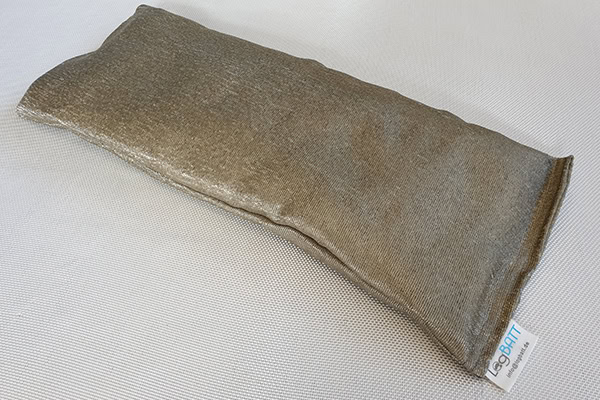
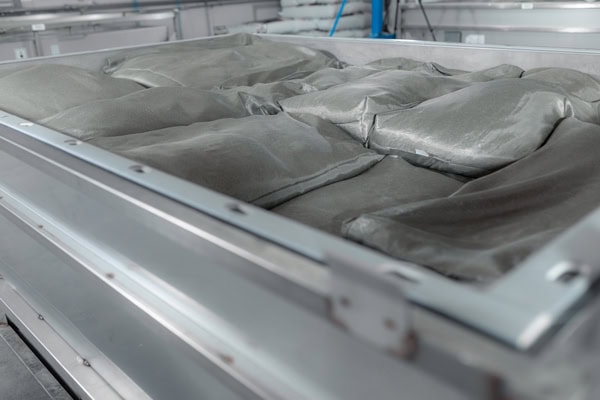
| LogBAG XL | LogBAG L | LogBAG M | LogBAG S+ | LogBAG S | |
| Length [mm] | 1,000 | 1,000 | 500 | 580 | 180 |
| Width [mm] | 1,000 | 500 | 500 | 400 | 450 |
| Height [mm] | 150 | 150 | 150 | 150 | 50 |
| Weight [kg] | 13.0 | 7.0 | 3.5 | 1.0 | 0.3 |
FAQ – Frequently asked questions about transport crates for lithium-ion batteries and lithium-ion cells
Which legal regulations apply to the transport of lithium-ion batteries?
Lithium-ion batteries are classified as Class 9 dangerous goods. Depending on the mode of transport, ADR (road), RID (rail), IMDG (sea) and IATA (air freight) apply. In Great Britain, ADR is applied to domestic carriage by the Carriage of Dangerous Goods and Use of Transportable Pressure Equipment Regulations 2009 (CDG 2009). The packaging must be UN-certified and hold a design-type approval. ADR special provision SP 376 describes which packing instruction must be met depending on the battery’s condition – from P903 for undamaged batteries to P911/LP906 for critically defective batteries. The SafetyBATTbox family from LogBATT covers all relevant packing instructions.
What do the UN numbers UN 3480 and UN 3481 mean?
UN numbers describe the dangerous substance. UN 3480 designates lithium-ion batteries transported separately from equipment. UN 3481 designates lithium-ion batteries contained in or packed with equipment. Both are subject to the ADR regulations for Class 9 dangerous goods. Depending on the model and the battery’s condition, the SafetyBATTbox is approved for both UN numbers.
What is packing instruction P911 and when does it apply?
P911 (LP906 for large packagings) is the strictest ADR packing instruction for lithium batteries and applies to critically defective cells – that is, cells or batteries that, under normal conditions of transport, are liable to rapid disassembly, dangerous reaction, flaming, dangerous heat generation, or a dangerous emission of toxic, corrosive or flammable gases or vapours. It requires UN-certified and design-type-approved packaging with gas management, thermal insulation and fire-protection cushioning. The SafetyBATTboxes XL-2.2+, XL-2.2, L-2, M-2 and S-1 are approved for this packing instruction.
When is P903 sufficient, and when do I need P908 or P911?
According to special provision SP 376, undamaged lithium-ion batteries in normal operation are to be packed under P903, and damaged or defective batteries under P908 – for example after mechanical stress, deep discharge or when defects are evident. Critically defective batteries must be packed under P911/LP906. Which SafetyBATTbox is suitable for an ADR-compliant transport depends on the battery’s condition, size, weight and energy content – see the LogBATT SafetyBATTbox product portfolio.
Is a design-type approval of the packaging mandatory for transporting lithium-ion batteries?
Yes. For the ADR-compliant transport of lithium batteries as Class 9 dangerous goods, the packaging must hold a valid design-type approval from the BAM (Federal Institute for Materials Research and Testing) or an equivalent authority. Self-built or non-approved containers are not permitted in commercial transport. All SafetyBATTbox models hold a BAM approval under ADR, which is recognised in Great Britain under ADR mutual recognition; the GB competent authority is the Department for Transport (DfT), with the VCA Dangerous Goods Office responsible for packaging certification.
Why are damaged lithium-ion batteries dangerous?
Damaged batteries can react thermally due to internal cell damage – generating heat, smoke gases, pressure build-up and, in extreme cases, a thermal runaway with fire spreading to neighbouring cells. The released gases contain toxic compounds such as hydrogen fluoride and carbon monoxide. For this reason, such batteries must be transported in tested safety containers such as the SafetyBATTbox.
What happens during a thermal runaway?
A thermal runaway is an uncontrolled, self-reinforcing thermal reaction inside a lithium battery. It usually starts through internal cell damage, overcharging, after a deep discharge or through mechanical damage, and leads to strong heat generation, pressure build-up, the escape of toxic smoke gases, electrolyte leakage and flames. The SafetyBATTbox is designed to withstand this emergency: mechanical protection against flames and projectiles, thermal insulation, and smoke-gas routing with a filter system for pressure relief.
Which SafetyBATTbox do I need for a critically defective EV battery?
For critically defective EV batteries and high-voltage storage systems, we recommend the SafetyBATTbox XL-2.2+. It is approved under LP906 for the ADR-compliant transport of critically defective batteries, takes batteries of up to 1,700 kg and has a gas management system. For smaller or lighter high-voltage batteries, the SafetyBATTbox XL-2.2 is also suitable.
What is the SafetyBATTbox family suitable for?
The SafetyBATTbox family is designed for the transport and storage of damaged, defective and critically defective lithium batteries of all sizes – from power-tool and e-bike batteries through industrial modules to complete EV battery packs. Different models cover the various ADR packing instructions and can be selected according to the battery’s size, weight and hazard class.
What is the difference between a transport box and a quarantine box?
A quarantine box is used for the interim storage of defective batteries and is also known as an emergency box (immediate measure in the event of damage) or evacuation container (removal from the hazard area on the company premises). A transport box is required for the ADR-compliant transport of a lithium battery in public spaces (road, rail, sea or air freight). With the SafetyBATTbox family, LogBATT offers the right box for every purpose. Transport boxes are also known as transport crates, transport containers, dangerous-goods boxes, dangerous-goods containers, fire-protection boxes and fire-protection crates.
Are LogBATT’s SafetyBATTboxes BAM-tested?
All SafetyBATTbox transport boxes hold a design-type approval from the BAM (Federal Institute for Materials Research and Testing) under ADR 2025. Depending on the model, they are additionally certified for packing instructions P903, P908, P910, P911, LP903, LP904, LP905 or LP906. The exact approval is stated on each product page.
Which materials are used for the SafetyBATTboxes?
Depending on the model, LogBATT’s SafetyBATTboxes are made of powder-coated steel, anodised aluminium or galvanised steel, with an inner tray made of heat-resistant stainless steel. The SafetyBATTbox S-1 and the lite models (SBB XL-lite and SBB S-1-lite) have a housing made of durable plastic.
Can I buy the SafetyBATTbox, or only rent it?
Both options are available. You can buy any SafetyBATTbox directly – either as a single model or as a fleet for regular transports. Alternatively, LogBATT also offers the SafetyBATTbox for rental, particularly for one-off or short-term uses such as recall campaigns or workshop incidents.
How do the LogBAGs work?
LogBAGs are reusable fire-protection cushions made of tested non-combustible material in accordance with DIN 4102. They cushion the battery inside the SafetyBATTbox, fix it in place without bulk fill and absorb escaping liquids such as electrolyte. Unlike loose fire-protection granulate, LogBAGs can be removed after use and reused multiple times.
Can the LogBATT SafetyBATTbox transport crate also be used for storage?
Yes. The SafetyBATTbox transport containers are designed as a combined solution for transport and storage. Defective batteries can be secured directly at the point of use in the box (quarantine storage), stored for any length of time and then transported onward in an ADR-compliant manner without repacking. This eliminates the need for separate storage packaging.